No Peeking!

swim peek

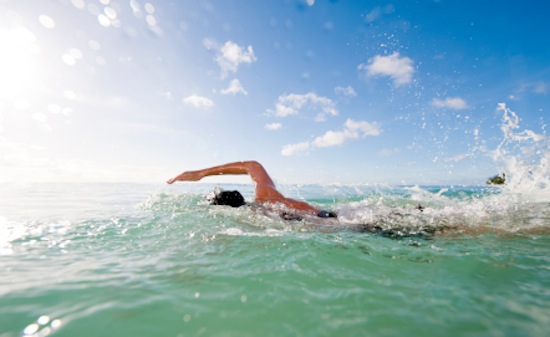
If you’ve ever been to a swim meet where young children were competing, you’ve seen The Peek. During the race, usually breaststroke, a swimmer will turn his/her head to check out the competition. Some little ones do this occasionally, some almost constantly, some are obvious, and some get very good at being subtle about it. And some never lose the habit.

It is an almost irresistible desire when you’re racing:  wanting to know where your competition is. Am I ahead? Am I behind? How am I doing?  Unfortunately, giving in to that temptation alters the outcome of your race. As soon as you change your head position to check out someone else, you change your body position, and ultimately change how you end up doing. You have no effect on the other person, but comparing yourself to them has changed YOUR race.

That’s pretty powerful.

Beyond the physical detriment to head and body position that a swimmer experiences by peeking, there is a mental/emotional effect as well. By expanding  your focus to include how someone else is doing, you let go of following your own plan and you allow their experience to become part of how you define yours. In a swim race, that can end up as either, “I did well because I beat Johnny” or “I did my best, but I lost to Johnny so it wasn’t that good”. Instead of comparing ourselves against our own plan or our own progress over time, it becomes about the comparison against someone else.

Comparing ourselves to others is the ultimate sucker’s game. There is no winning this one. There will ALWAYS be, for EVERYONE, someone who has more, is better at something, etc. We all have people who make us feel inferior. Social media hasn’t helped, since now we can peek into other people’s lives with impunity, forgetting that Facebook is the ultimate ongoing “Christmas Letter”, full of everyone’s surface wonderfulness. Reading Facebook, one would think that no one is unhappy, failing school, a bad cook, fighting with their kids, in danger of being laid off, unable to afford vacation, or worrying that their spouse is cheating on them. We are all looking around, peeking constantly at our “competition”, and becoming more and more convinced that we are “losing”.

Comparing ourselves to others alters the outcome of our journeys, plain and simple. We cannot be our best selves if we are focused on someone else. We cannot be truly happy and at peace if we define success in terms of someone else’s journey. When we make comparisons, we only hurt ourselves in the end.

So, at least for today, No Peeking!
It’s What You Take Away From It

Swim-wall

As a swimmer and a coach, as someone for whom water has played a major part in life, the thought of drowning is beyond horrifying. Being in my wonderful, peaceful, familiar environment and not being able to manage the situation is the worst kind of helplessness I can fathom.

I was 18 years old, swimming for my summer league team. I had quit year round swimming the winter before, choosing instead to swim for fun and to coach for both my year round and summer teams. Life was good, and I was enjoying swimming wholeheartedly for the first time in a long time.

It was our All Star meet, our end of season championship, and I was going into it seeded first in my best event, the 50 backstroke. Things couldn’t have been better:  great weather, the support of my team, my favorite stroke, the middle lane, my last swim of my career. I was ready to go out on a high note.

I got a great start, but then the unthinkable happened:  my goggles came down. This almost NEVER happens in backstroke, but there they were, right across my mouth, positioned so they were dumping water up my nose, in my eyes, and down my throat. I swam on, thinking “What the heck? It’s only a 50, I’m in good shape, I’ll just hold my breath.”  I was ahead going into the turn, which was usually the best part of my race. As I pushed off, another unthinkable thing happened:  I came up under the lane line. The line was across my right shoulder, and I was stuck there, trying to fight my way up, having not been able to see or breathe since the start of the race. Thrashing my way to the surface, my lungs screaming, I gasped involuntarily, and sucked in water. That was it. The end of my race. I could not go on.

Here’s the kicker:  as I got to the side and an official helped me out, I coughed out a big ball of water and looked up just in time to see my dad make a gesture of disgust and leave the pool deck. No concern for my well-being, just disgusted disappointment in me for “quitting”. I was beyond devastated. Crushed and embarrassed to have disqualified in my best event, scared to death by inhaling water and going under, I then had to deal with my own father’s lack of care and his misunderstanding of what had occurred.

Needless to say, I had emotions about this one for a long time. A loooooooong time. Finally, I was able to put this incident in a perspective that helped me deal with it and get past my negative feelings, by asking myself “what did I learn from it?”  I learned that sometimes, for no particular reason, bad stuff happens. I learned that sometimes, try as you might to fight your way out of it, the bad stuff can keep coming and get the better of you for a time. I learned that sometimes stopping to regroup is the best choice you have. I learned that sometimes the people watching your struggle, even the people who love you the most, will misunderstand and have opinions and judge you. Most importantly, I learned that you don’t have to let any of that define you or become a permanent part of your self-image.

I lost a medal that day, but what I took away was far more valuable. In the end, that’s all that matters.

The Dreaded “Speedo”

swimsuits

I put the name Speedo in quotes here to denote the generic way in which this particular brand name has become synonymous with the really tight, itty-bitty racing suit. I in no way am either trying to endorse or bash the brand name product.

We’ve all seen them, mostly at swim meets, but sometimes (unfortunately) on the beach. When worn by a competition swimmer, they seem like an appropriate uniform for the sport, albeit a tiny one. There is nothing quite like trying to squeeze yourself into the smallest possible, tightest possible suit, then trying to move and move FAST. Oh, unless it’s putting yourself up on a starting block two feet above everyone’s head while you’re wearing said suit. Make no mistake, we swimmers have all heard the jokes and comments about how we look and what can be seen through the tightness of the suit. We know that every ounce of excess skin or body fat gets pushed out to the edges of the suit. We know that every defect, every pimple, every hair is visible through the material.

Talk about feeling vulnerable.

There are not many sports where putting on your uniform means taking off your clothes to this extent. There is an overcoming of self-consciousness and an acceptance of emotional nakedness that swimmers must learn to deal with. (Some are better at it than others, and are usually the ones who, as adults, will walk through the locker room naked while the rest of us are wondering what the hell their problem is.)

It is daunting to bare yourself in any sense, to “put yourself out there”, to open yourself to the judgments of others. Most of us avoid doing that at all costs. We clothe ourselves with degrees and job titles and the “right” house and friends in order to protect ourselves from the vulnerability of showing who we really are. What flaws might be seen? What might people think or say?

It is interesting to observe young swimmers move from a complete uninhibited lack of awareness into the extreme self-consciousness of puberty. Some kids will quit the sport because it’s just too uncomfortable to be that exposed and vulnerable, or develop coping strategies like hiding in the locker room or wrapping in a towel. The really interesting part is seeing how they move through the agony of feeling exposed back into a lack of inhibition, as though just the repetition of being “out there” takes away the fear of it.

Choosing to be vulnerable, to put our real selves on display, to brave the eyes and judgments of others. Repeating it until we no longer fear it, until being our true selves is uninhibited habit. A good lesson for all of us, perhaps.

YAAAAAAAYYY Tired!!

23031424-young-man-with-book-sleeping-by-pool

There is no way to train a swimmer to be fast over distance without making them uncomfortable. The hardest part of coaching in my opinion is getting kids to accept, and even embrace, being tired and uncomfortable.Please note that I am NOT talking about ignoring injury pain, which is sharp and breath-taking and a show-stopper. I am referring to the dull achiness of fatigued muscles, muscles which have been doing their jobs as nature intended and are just tired.

It is a very natural, human, self-protective response to back away from physical discomfort and fatigue. It takes a huge amount of mental control and fortitude to continue to push and move and exert, when everything in your body is screaming at you to stop. It also takes understanding that there are rewards on the other side of that discomfort in order to find the motivation to push.

One of my coaching mantras was “Yaaayyyy Tired!!”  I used this to help the swimmers understand that their fatigue and discomfort was not a bad thing, that it was not a barrier unless they made it one, and that they had control of it. They could choose to have a different attitude about it. Instead of thinking negatively, “I feel bad, I hurt, I’m tired, I want to quit”, they could choose to put a positive spin on it, as in “I’m getting stronger, I’m overcoming this, YAY I’m tired!!”  Being Yay Tired was a badge of honor in my groups, and it was a way of signaling to me that they had pushed past wanting to stop.

Embracing Yay Tired is a crucial mental victory. It is an acknowledgment that things in life aren’t easy, that we need to work and sweat and earn what we want, but that when we accept that and even seek it out, our achievements are far sweeter. This is where true self-esteem is born: in the sweating and discomfort, in the pushing to continue on, in not letting your own fears get in your way. It is in overcoming a challenge and conquering that voice that urges us to quit that we find our greatest strength.

Walls

underwater


Walls and how we handle them are pretty important in swimming. There is only one individual event in all of swimming, the long course 50 meter freestyle, that doesn’t involve a turn and pushing off of a wall. How we approach them, how we leave them, our speed in and out, how hard we push…all of these are crucial to our success in handling walls.

The wall is a physical barrier that must be dealt with in our sport, but it is also a mental/emotional one. The tendency of most young swimmers is to slow down at the wall, perhaps to catch that extra breath at the turn or in anticipation of the end of the race. One overshot turn resulting in a cracked ankle or banged arm can cause a swimmer to slow in fear around walls for years. It takes a lot of training to master the gut response to see the wall as a stop signal.

It is in our nature to slow at a wall, to look up at it, to ponder how to get past it. Our tendency is to assume our path continues on past the wall, following the track we have been on, and that the wall stands in our way. In swim training, we must overcome this mindset:  our path does not continue on, but resumes in another direction. The wall becomes a chance to speed up, to readjust, to jump off and speed away on our new path. The wall is not obstacle, but opportunity.

In preparation for writing this, I looked up the definition for the word wall, and was interested to find this:  an extreme or desperate position or a state of defeat, failure, or ruin.I have certainly faced that kind of wall in my own life, and am facing one now. I have reached my goal of getting all three of my children raised to college age, in college and doing well. All are out of the house, and my path seems to have ended at a giant wall. What now, what next? This wall has been looming for a couple years, and I now stand in front of it, feeling a bit desperate. I cannot see past it.

I must return to what I know from swimming:  I must speed toward this wall, and see it for the opportunity it is. My path is on a different course, one that I cannot yet see. I need to have the confidence to race at this wall, lower my head, hold my breath, flip and jump as hard as I can in my new direction. The path will be there, and this wall that seems so daunting is my best chance at finding it.

Broken Goggles

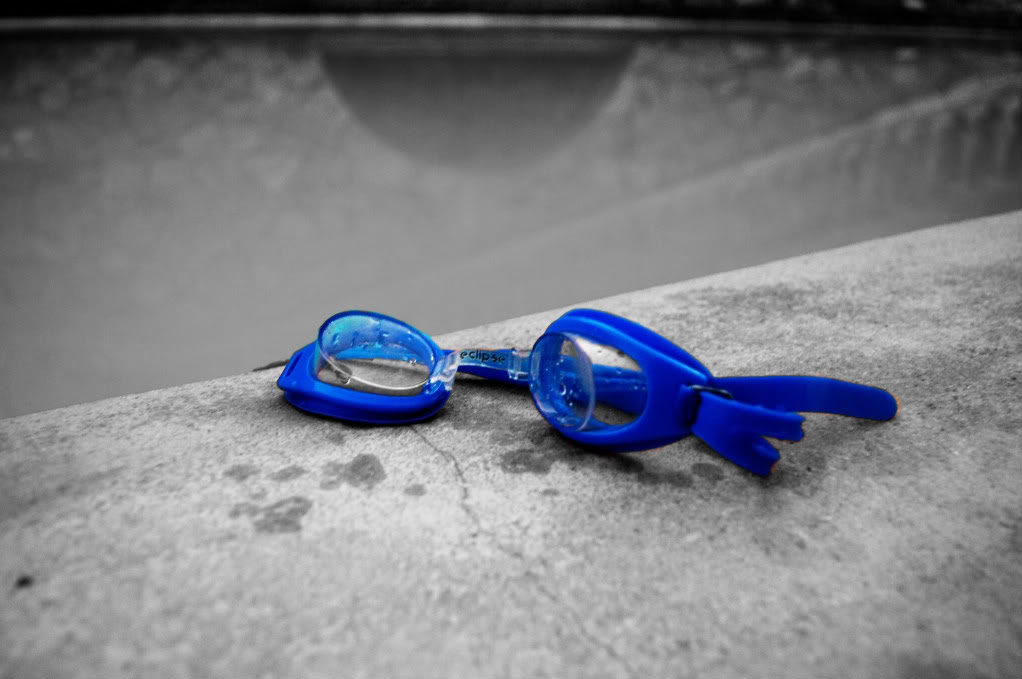
goggles

Coach:  “Why did you stop in the middle of the race?”
Child: (sobbing) “Because my goggles were leaking!”
Coach: “OK, so… it’s just water. Why didn’t you keep going?”
Child: (sobbing harder) “Because they were LEAKING!!!!!”

Every sport has its equipment, and swimming is no exception. Probably the most heavily relied upon item are the goggles, which keep the chlorinated water out of swimmers’ eyes. I hate goggles. HATE them. They break, they leak, they require frequent adjustment, and worst of all, most everyone thinks they can’t swim without them.

My real issue with goggles is that they are not necessary. They are a convenience, they are nice for helping you see clearly and for not ending up with stinging eyes at the end of the day…but in reality, you can still swim without them. One of my all-time favorite moments in swimming was Michael Phelps’ 200m butterfly win at the 2008 Olympics…you know, the one where his goggles filled with water off the start and he raced 200 meters unable to see clearly, the last 50 not really being able to see at all. I like to tell that story and end with, “See?  You don’t NEED goggles!”  (I get a lot of groans and rolling eyes from the kids.)

Broken goggles represent an inconvenience, an unexpected minor setback, yet too many turn it into tragedy. Broken or leaky goggles become an excuse and an insurmountable obstacle, with swimmers allowing themselves to mentally fall apart because of a minor failure of a piece of unnecessary equipment.  I read an interview with Bob Bowman, talking about training Michael Phelps. Part of what he said was that he used to train Michael for adversity, and do things like step on his goggles right before a race. Awesome! What better way to teach resiliency in the face of setbacks?

I have wondered on occasion if daily life in this country is just too easy. We flip a switch, light comes on. We turn a faucet, clean water comes out. We click a mouse, instant access to the world is there. Is it any wonder that people raised in that environment come undone when something unexpected and (GASP!) uncomfortable happens?

Kids who swam for me learned pretty quickly that goggle issues were not an excuse that was going to gain them any traction with me. In fact, I have run practice sets where kids were not allowed to wear goggles, or had to pull them down around their necks, or had to deliberately fill them with water, in order to teach them how to deal with the minor adversity. We spent a lot of time at practice talking about the difference between inconveniences and problems, and about being focused enough to swim through the inconveniences. I encouraged them to see these little issues as opportunities to build mental toughness, and I even had a few who listened.

What are the “broken goggles” in your life? How do you respond when it happens? Are you able to stay focused and move forward, seeing it for the minor adversity it is? Or do you let it derail you? How resilient are you?

Step on your goggles once in a while. You’ll be glad you did.

Swim IN Your Life

swimming_ocean

I recently made a name change to this blog (as my tiny band of followers may have noticed), and basically swapped a three-letter word for a two-letter word. What I discovered is that it caused a major, and very positive, change to the meaning of my title.

One wouldn’t think simply swapping the word “for” for the word “in” would warrant this much attention.  (I mean, REALLY, Jill! How much can you talk about this?!)  There ended up being such a profound change in meaning, and a very slick double meaning, that I just can’t resist going on about it for a bit.

The superficial meaning of Swim in Your Life is simply that:  I’m a great believer that everyone should have swimming in their life as a sport or activity, that everyone should know how to swim for safety. In other  words , “In your life, swim.”

The other meaning is that swimming is a way to think of moving through your life. “For your life” is detached and feels external, as though your life is over there somewhere. “In your life” is intimate, personal and immersive, and fits much better with the idea of swimming. When we swim in water, the water envelops us, touching us everywhere; we feel it with our whole body, and our whole body is involved in moving through the water. To get into water, we jump, plunge, leap, or at least slide in and commit. Swimming, like life, requires you to be all the way in—it does not happen to you, you must take charge and make it happen.

A small word change, a happy accident.  Immerse yourself in your life, use all of your mind and senses to feel it and move through it, make it happen.  Swim in your life.

Going Under

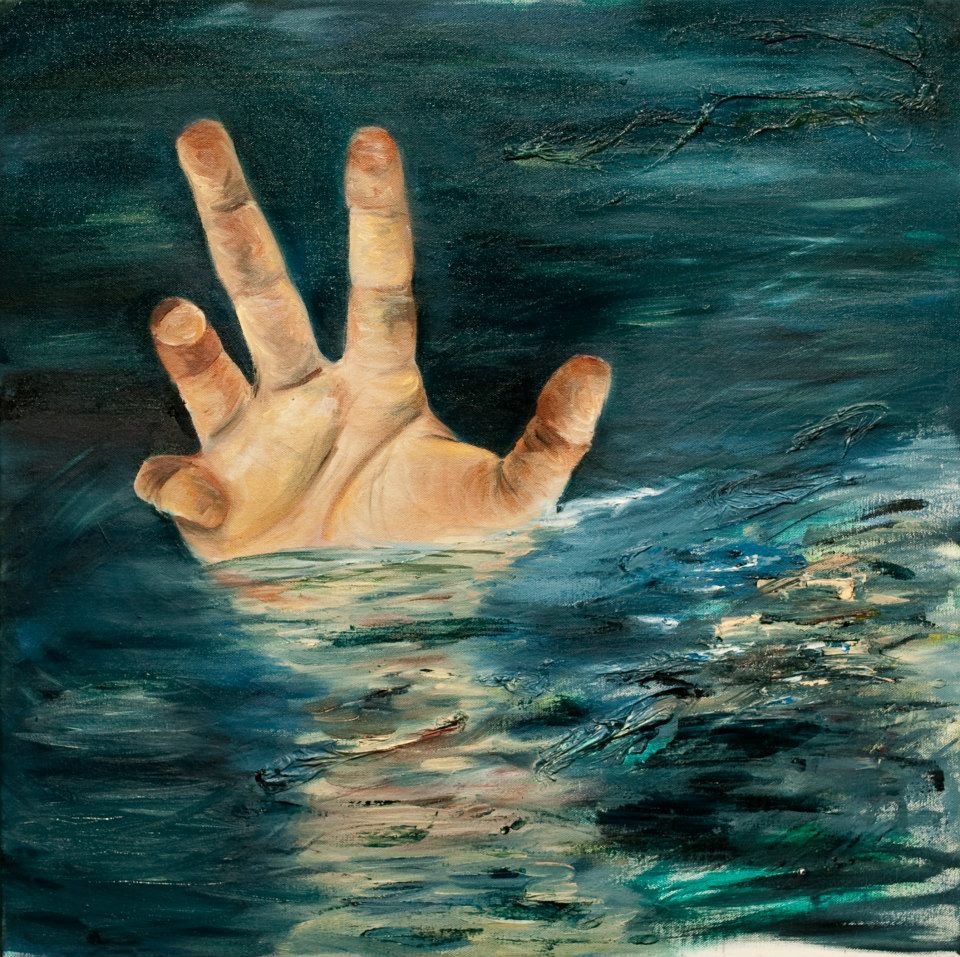
going under    (artwork by Hannah Grace)

It doesn’t happen often, but swimmers in distress DO happen and coaches are required to be certified in lifesaving or coaches’ safety, first aid and CPR for this very reason. We need to know what to do and how to do it even though the vast majority of our swimmers are very adept in the water.

She had come to my high school team, like most of the other kids, to get better at swimming. She told me she knew how to swim, but there was something in her tense body language and ill-fitting swimsuit that raised a red flag for me. I put her in the lane next to the wall, and stayed close. Sure enough, as soon as she realized she couldn’t feel the bottom anymore, she went rigid, flailing, body vertical, eyes bugging out. She was drowning. I could see the panic in her eyes as I reached for her hand, panic that did not fade quickly even as I pulled her to the side.  I was ready for it, I knew it was coming, so was able to reach her, get her to hear me, have her grab my arm and let me pull her in.

The panic finally left, and in its place was embarrassment. The teenager, self-conscious in her lack of skill in front of her peers, had tried to bluff her way through and gotten caught. Too proud to admit her weakness and ask for the help she needed, she floundered. She needed help. There is no harm in that, no stigma, other than what we put on ourselves. She needed help, yet by not admitting it up front, she ended up risking real harm.

We all do this, although not usually in such dramatic ways. We act cool in a group, feign knowledge in a meeting, keep a stiff upper lip when our marriages are falling apart….why? We hold it together and try to bluff our way through, only letting on that we are in over our heads when it’s too late, when panic has us going under…why?

I have no answer for this, I only know it’s true. I see my friends do it, and I do it myself. Like that teenager, we seem to think we need to have all the knowledge, all the answers, all the strength, or we are weak, or we are failures. In our pride, we risk a greater fall. In our self-conscious unwillingness to admit we need help, we create a larger problem.

The great tragedy of that day is not that she floundered and almost drowned; it is that, overcome by embarrassment, she did not stay. She left, never to return. She left, stuck in her fear, her pride, and her self-consciousness, never having learned that in asking for help to begin with, she could have learned to save herself.

The Breakout

breakout

You wouldn’t think we would spend so much time talking about pushing off a wall, but I’m willing to bet that at least a quarter of our practice time was routinely consumed with just that: how to push, how to hold a body position, how long to kick, which arm to begin pulling with first, when to breathe. When you consider that a third of the race yardage in a short course pool takes place around the walls, the “breakout”, or how to get away from the wall and take those first few strokes, becomes enormously important.

Those first few steps in any endeavor are crucial. That’s where you set the tone and pattern for everything that follows. In swimming, a breakout done poorly, haphazardly, thoughtlessly, can limit what you can achieve and put you behind significantly, as well as waste your energy as you struggle to catch up. Being out of position or caught in your own turbulence creates resistance that tires you out needlessly and has a negative effect on you mentally as you fight to resurface and gain back that time just lost. A well-executed breakout, on the other hand, is an opportunity to leap ahead and improve one’s position, causing the swimming that follows to feel more powerful and efficient.

One of the uniquely beautiful things about swimming is that every length of the pool is a chance to start over, to do the breakout again, to readjust and set a different tone. It’s all part of the same race or the same training set, but it is still a fresh start in miniature. “THIS time I will push hard with both legs. THIS time I will squeeze into a tight streamline. THIS time I will kick hard. THIS time I will not breathe on the first stroke. THIS time my first strokes will be strong.” As a consequence, THIS time there will be a new outcome.

What an awesome life lesson! How many times do we face moments where we can choose to make some changes or continue on struggling? How many times do we choose the struggle simply because it’s familiar? How many times do we choose mindless habit, no matter how much it wastes our energy?

Our breakouts, our fresh starts, should always be mindful moments, moments of focus and concentration, because these are the moments where the pattern is set for what is to follow. Small, positive changes right there in that moment of pushing off and starting anew can lead to larger positive outcomes as you swim away. Capture those moments. Focus. Be mindful. It can make all the difference in your life.

Ready…GO!

start-gun

I’ve said it a million times AT LEAST. Most of the time, it’s been said with less than a second of hesitation between the words, with the implication being that the person I was talking to really should have been “ready” before I told them to be. Think about that. Be ready before the warning comes, and know what to be ready for. It reminds me of the old Boy Scout admonition to be prepared, and I think it carries the same meaning. Be ready, be prepared, for….anything!

Beginnings are so important. They can often lay the stage for what comes next, but mostly just the act of starting is an act of faith. In swimming, the start is literally a headfirst jump through the air, trusting in the work that’s come before to land you correctly in the water to begin your race. The start, the dive, is one of the hardest skills to teach a beginning swimmer because it is absolutely counterintuitive for humans to voluntarily fly through the air headfirst. It takes countless numbers of repetitions to make it comfortable to do so, and a countless number more to make it an instinctive response to a visual or audible cue. It is practiced vulnerability.

I’ve worked with many children for whom that leap was almost impossible, and who would look forward, or raise up, or bend like a crab to get those knees under them. Unable to leap headfirst, they instinctively protected themselves, and the older they got without mastering this skill, the more entrenched their caution became. The imagined hurt became more and more real, the avoidance more and more justified. No amount of rational discussion will change this, so coaches learn to rearrange circumstances to result “accidentally” in the desired outcome, breaking the dive action into small, doable, seemingly unrelated pieces. In other words, we trick them into success by making it almost impossible to fail.

All too often in adult life, we forget this type of process. We put enormous pressure on ourselves to be a certain way, or have certain things, and we become daunted by even trying to begin. Where to begin? How to begin? We have our eyes fixed so firmly on the end of the race that we have forgotten the beginning…or even the pre-beginning. What have we done to get ready to leap? How have we prepared? How many countless times have we practiced the kind of vulnerability it takes to begin?

A successful swimming start is far more about the being ready to leap than it is about the efficacy of the push off itself. In coaching, we talk a lot about “reaction time”, or how long it takes the swimmer to react and begin motion once the cue is given, and we measure this to try to help athletes improve. But to my mind, this is not just physical, not just a matter of having fast twitch muscles in the right proportions. It is about the readiness of the mind, and the willingness of the spirit. It is about having confidence in the practiced vulnerability of the headfirst leap, about being “ready” in a gut-level, faith-filled kind of way.

I retired from active coaching several months ago, in an effort to “ready” myself for whatever comes next. It is a sabbatical kind of time, but also a time of practicing vulnerability. I have been training myself to let go of what is familiar, let go of my preconceptions or my ideas of what my life should be, and ready myself for the leap that comes next. I am trying to live my own lesson, and rearrange circumstances to accidentally result in the desired outcome.  Whatever the task is, break it into pieces, small enough to do just a little each day, and set aside some “practice time”, with the only measure of success being whether or not you went to practice and moved things forward, no matter how slightly. I hope to trick myself into success.